ELT Data Pipeline
using Python, DBT,
Airflow & Docker
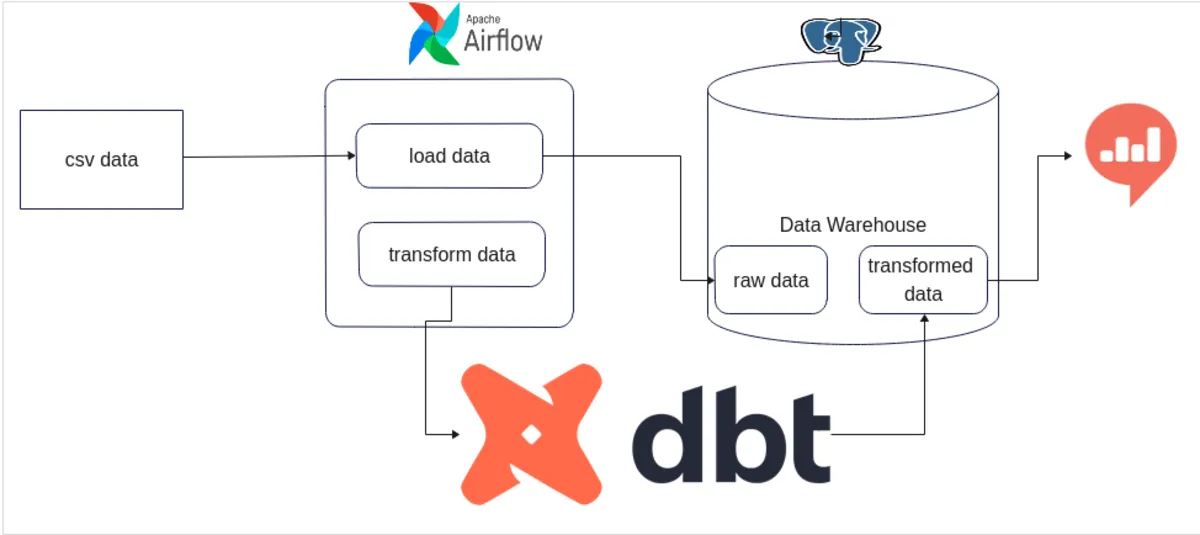
Used Python Language to write ELT script .
Used Data Build Tool(DBT) to Transform the Data .
Used Apache Airflow to streamline & automate complex tasks.
Implemented Docker to containerize the application.
PostgreSQL to store both raw & transformed data.
Python ELT script code 🚀
                        import subprocess
                        import time


                        # Configuration for the source PostgreSQL database
                        source_config = {
                            'dbname': 'source_db',
                            'user': 'postgres',
                            'password': 'secret',
                            'host': 'source_postgres'
                        }

                        # Configuration for the destination PostgreSQL database
                        destination_config = {
                            'dbname': 'destination_db',
                            'user': 'postgres',
                            'password': 'secret',
                            'host': 'destination_postgres'
                        }


                        # Command to check if the data already in destination_db or not
                        check_destination_db_tables = [
                            'psql',
                            '-h', destination_config['host'],
                            '-U', destination_config['user'],
                            '-d', destination_config['dbname'],
                            '-c', "SELECT EXISTS (SELECT 1 FROM public.users LIMIT 1);"
                        ]

                        # Set the PGPASSWORD environment variable for the source & destination database
                        source_pwd = dict(PGPASSWORD=source_config['password'])
                        destination_pwd = dict(PGPASSWORD=destination_config['password'])

                        # Execute the command to check if table/data in source_db & destination_db
                        destination_db_result = subprocess.run(check_destination_db_tables, env=destination_pwd, capture_output=True, text=True)


                        if destination_db_result.returncode != 0:

                            print("Destination Database is Empty!! Initiate executing ELT script ...")

                            # Use postgres ibuilt 'pg_dump' command to dump source database data to a .sql file
                            dump_command = [
                                'pg_dump',
                                '-h', source_config['host'],
                                '-U', source_config['user'],
                                '-d', source_config['dbname'],
                                '-f', 'data_dump.sql',
                                '-w'                    # -w flag, do not prompt for password
                            ]

                            # Executing dump_command using subprocess.run()
                            subprocess.run(dump_command, env=source_pwd, check=True)


                            # Use psql to load the dumped SQL file into the destination database
                            load_command = [
                                'psql',
                                '-h', destination_config['host'],
                                '-U', destination_config['user'],
                                '-d', destination_config['dbname'],
                                '-a', '-f', 'data_dump.sql'
                            ]


                            # Execute the load command
                            subprocess.run(load_command, env=destination_pwd, check=True)

                            print("Successfully finished loading data into destination database ...")


                        elif destination_db_result.returncode == 0:
                            print("There may already have data inside the destination_db table OR Database connectivity issue.")
Airflow code 🚀
                        from datetime import datetime, timedelta
                        from airflow import DAG
                        from docker.types import Mount

                        from airflow.operators.python_operator import PythonOperator
                        from airflow.operators.bash import BashOperator
                        from airflow.providers.docker.operators.docker import DockerOperator

                        import subprocess


                        # default configuration options for DAG
                        default_args = {
                            'owner': 'airflow',
                            'depends_on_past': False,
                            'email_on_failure': False,
                            'email_on_retry': False,
                            # 'retries': 1,
                            # 'retry_delay': timedelta(minutes=3),
                        }


                        # function to run the elt_script.py
                        def run_elt_script():
                            script_path = "/opt/airflow/elt_script/elt_script.py"
                            result = subprocess.run(["python", script_path], capture_output=True, text=True)

                            if result.returncode != 0:
                                raise Exception(f"ELT Script failed with error: {result.stderr}")
                            else:
                                print(result.stdout)


                        # Creating/Declaring a DAG object
                        dag = DAG(
                            'elt_and_dbt',
                            default_args=default_args,
                            description='An ELT workflow with dbt',
                            start_date=datetime(2024, 2, 13),
                            catchup=False,
                        )


                        # Setting our first task t1 (i.e To run elt_script.py from docker container)
                        t1 = PythonOperator(
                            task_id='run_elt_script',
                            python_callable=run_elt_script,
                            dag=dag,
                        )


                        # setting 2nd task t2 (i.e To run 'DBT' from docker container)
                        t2 = DockerOperator(
                            task_id='dbt_run',
                            image='ghcr.io/dbt-labs/dbt-postgres:1.4.7',
                            command=[
                                "run",
                                "--profiles-dir",
                                "/root",
                                "--project-dir",
                                "/dbt",
                                "--full-refresh"
                            ],
                            auto_remove=True,
                            docker_url="unix://var/run/docker.sock",
                            network_mode="bridge",
                            mounts=[
                                Mount(source='/home/dhiraj/Desktop/data-pipeline-with-python-dbt-airflow/data_transformations', target='/dbt', type='bind'),
                                Mount(source='/home/dhiraj/.dbt', target='/root', type='bind'),
                            ],
                            dag=dag
                        )


                        # Task dependencies for execution of all DAG tasks in Order
                        t1 >> t2